Sunday, October 26, 2014

Term Paper Season in Stonewall

As more than half the semester is behind me, that can only mean one thing ahead-- term papers. You might be surprised to find that I am not in mourning over this, but in fact am very excited to learn more. For my historical methods class, I will be writing my term paper about the Stonewall Riots that took place in New York City in 1969.

The infamous Stonewall Inn
I do not know much about the Stonewall Riots other than the popular details: it was the beginning of the gay rights movement in the US, it took place at the Stonewall Inn, and it was started by a group of drag queens, male prostitutes, homeless youth, and other such groups. I do not know the scale of the riots nor the circumstances surrounding the riots. However, I am excited to learn more, and I am ready to start research.

So far, I have found a critically acclaimed primary source written by author David Carter called Stonewall: The Riots that Sparked the Gay Revolution. It contains first hand accounts of the riots from rioters and bystanders, but it also explores the circumstances surrounding the riots including: the everyday treatment of LGBT people, the legislation in place targeting LGBT people, and what exactly sparked the riots. In that sense, this book functions as both a primary and secondary source.

Besides this primary source, I am looking up any information I can find in my college's library, and it seems like I will have no problem finding resources. For the first time in my life, I may even cite a documentary! All in all, I am excited to dive in.

The Stonewall Riots in action

Sunday, October 19, 2014

Preparing for Historical Debate: Did U.S. policies promulgate and extend the Cold War?

For my Historical Methods class, our instructor has decided to assign students into groups embodying two viewpoints on whether or not U.S. policies promulgated and extended the Cold War or not. I was assigned to the group that asserts that U.S. policies did not promulgate and extend the Cold War. I will admit to at first despairing that I was assigned to the group I was because I believed that U.S. policies absolutely led to and extended the Cold War, my attitude had radically (and delightfully, I might add) changed. Indeed, I have a a great group of other students to work with, and I believe we are off to a great start. Though we have not had a chance to meet up and discuss our debate plan, we have been working diligently, and so far, research seems promising.
My skeptical self before I started research. "I don't know how I feel about this prompt..."
 
The research has not only been promising, but also quite surprising. Without giving away too many details, my research has help illustrate the complexities of the Cold War from not only American but also Russian and British perspectives. One of the most surprising things I have learned is that Americans and Russians were not of one mind, and the changes in American, Russian, and British policies throughout the Cold War reflect this from both a "great man" and a "bottom-up" historical interpretation.
The gears in my head turn as I researched. "Hmmm, that's jolly good stuff. Maybe there's something here..."


Suffice to say, I am very much looking forward to meeting with the other students in my group, and I am even more excited to begin the debate. I believe it will be a fun competition, but I am more excited to arrive at truth. After all, I believe a debate is less about winning an more about arriving at truth. No matter what happens, I think I will leave the debate a few steps closer to truth, and that is enough for me.
BAM! I am changed forever by this research.


Thursday, October 16, 2014

Mickey Mouse and American Neurosis

In historian Mike Wallace's Mickey Mouse History, Wallace explores how Disney theme parks have affected American understanding of history. Specifically, Wallace considers how Disney's the Hall of Presidents, The American Adventure, and other attractions affect American understanding of history. However, for the sake of brevity, the post will only specifically explore Disney's The American Adventure seeing as it the youngest of the attractions related to history.

The American Adventure offers and idealistic run through of American history from Pilgrims arriving on North America's shores to "American Future." Though the presentation notes conflict in American past, figures like Martin Luther King Jr. are presented as more icons that actually spokespeople for their particular movements (150-152). Indeed, conflict in American past is hardly explored at all; instead, America is presented as a nation that has dealt with its past conflicts and moved on (152). The presentation is also curiously silent on important events in American history such as labor movements and the Vietnam War. In the end, America is displayed as a country with "imperfect but still inevitable progress" who has risen above the problems of the past despite current difficulties with poverty, sexism, racism etc (150).

A scene from Disney's The American Adventure
Wallace examines The American Adventure and other Disney "historical" attractions, and he concludes that they are less historical and more historicidal. They distort history unabashedly in a public setting where millions of people visit each year. Noting the popularity of such attractions, Wallace believes that this is a symptom of problems with American's understanding of history. "I think the country at large needs to reflect upon the consequences of the corporate commodification of history" (154). He asserts that if a country feels the need to alter or repress memories of itself, it could be a symptom of historical neurosis. He hauntingly concludes, "The past is too important to be left to the private sector. If we wish to restore our social health, we had better get beyond Mickey Mouse History" (155).

I believe that the best way to address a problem is to being as transparent about it as possible with one's self. In the same way, if a community has a problem it is often best to address the problem with as much honesty and transparency as possible no matter how difficult one's past may be. To do otherwise, to do as Disney does, is to allow the problem to fester as the community carries on with a kind of mania that will demand a reckoning eventually. America the free only if it retains its history.

Wednesday, October 8, 2014

Historical Controversy: US Reaction to the Initial HIV Epidemic in the US

The LGBT+ community, like many minority communities, have a history of oppression. The oppression ranges from the more acute form as seen in the mass killings of homosexuals during the Holocaust to less acute (but still damaging) forms of oppression such as a family asking a homosexual relative to live in the closet. I believe many American people would like to think that the US has not participated in more acute forms of oppression in a long time, but some argue that the way the American public handled the outbreak of HIV in the US constitutes just that-- acute oppression of the LGBT+ community.

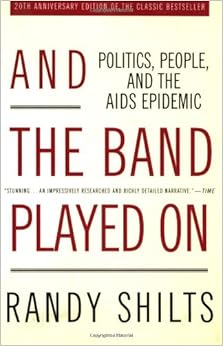
Beginning around 1980, homosexual men and IV drug users began to come into medical offices with strange diseases; this was especially prevalent in urban areas with large numbers of homosexuals. As these patients began to die, and larger numbers of patients came into medical offices with the same symptoms, city health departments began to take action. Journalist Randy Shilts in And the Band Plays On writes extensively on how San Francisco's Public Health Department did an excellent job in tracing the spread of the disease, but he also writes how other cities' Public Health Departments such as New York City's simply played off the issue as a "gay affair" despite the deaths (310). Shilts believes this was because at first, HIV only affected homosexual men and IV drug users-- a reflection of America's homophobia. As the disease spread, the media called it "gay cancer" even as heterosexuals begins to fall victim to the disease-- a further reflection of America's homophobia (137).
San Francisco's Castro District, one of the areas hit hardest by the initial HIV outbreak
The US Center for Disease Control (CDC) remained effectively silent on the issue by not funding research at all (292-293). As the death toll grew higher and higher, the Reagan administration responded in 1983 calling it America's "Number One Health Priority," but the Reagan administration gave no extra funding to the Centers for Disease Control or the National Institutes of Health (NIH) for research (293-294). Shilts accuses Ronald Reagan himself of "ritualistic silence" until he publicly addressed the American people on the now termed AIDS epidemic in 1987 (588). To further illustrate his point, Shilts compares the NIH's spending on another public health crisis at the time (1976), Legionaire Disease, to their spending on the AIDS epidemic. The NIH spent roughly $34,841 per death from Legionaire Disease, but the NIH spent $8,991 per death from AIDS in 1982 (186).
A truly harrowing yet enlightening book.
Call it a sin of omission, but I do agree with Shilts when he says America's response to the initial outbreak of HIV reflects its homophobia at the time. Indeed, I still encounter people who believe HIV is simply a disease that affects only homosexuals. Regardless of how one feels, America's initial reaction to the HIV epidemic continues to spark great controversy, and perhaps this will lead to greater dialogue in how to address this terrible disease that does not discriminate.

Sunday, October 5, 2014

The Museum-Public Relationship

Author John Donne once wrote how "No man is an island," and I believe Donne succinctly demonstrates how man is a social being in those few words. No man is such a radical individual that he can live entirely unaffected by his environment. Furthermore, man exists in relation to others. For instance, a man is a son in relation to a parent and a husband in relation to his spouse. In "No Man is an Island," Donne artfully shows how man is a social and relational being, and I believe this concept can tell us something about public museums and their purpose.


To review, a public museum is a museum that is run by a board of directors as is the case with public museums. However, public museums differ in that they rely on donations from major public sponsors and the generosity of society at large. For instance, the Smithsonian relies on funding from the US Government and depends on generosity from Congress to keep its doors open.

In a sense, a public museum enters into a relationship with the public, so a public museum is a social entity. Because of this, a museum must keep their public's interest and beliefs in mind. However, a museum still has an obligation to educate and challenge the public to discern their place in the world in light of the past. As in all relationships, there are times of tension, and sometimes, public museums do things that come into conflict with the public.

For instance, the National Air and Space Museum in Washington D.C. came into conflict with WWII veterans and members of the Republican party when they opened an exhibit exploring the US decision to drop nuclear bombs on the Japanese cities of Nagasaki and Hiroshima. Many people raised concerns that the exhibit held too harsh a view of America at the time of the bombs' dropping. The dissenters to the exhibit believed that the museum lead people to see Japanese as innocent victims of American Imperialism. The controversy grew so large that even members of Congress became involved. They demanded that the museums change the exhibit In the end, the museum decided to remove the aspects of the exhibit that offended so many.

The National Air and Space Museum
However, some see this as an unjust censoring of the museum. They believed this censoring compromised the truth the museums sought to communicate with the public.

Regardless of how one feels about the aforementioned controversy, one thing is certain-- public museums must act with a mind towards the public they serve. Museums cannot and nor should they try to act independently of their public. This is not to say that museums must compromise the truth and depth of their exhibits, but it is to that museums must operate with a degree of finesse in respecting both the past and the public. Of course, as all relationships are, the museum-public relationship is a two-way street, so the public must also treat the past and museums with respect.