The LGBT+ community, like many minority communities, have a history of oppression. The oppression ranges from the more acute form as seen in the mass killings of homosexuals during the Holocaust to less acute (but still damaging) forms of oppression such as a family asking a homosexual relative to live in the closet. I believe many American people would like to think that the US has not participated in more acute forms of oppression in a long time, but some argue that the way the American public handled the outbreak of HIV in the US constitutes just that-- acute oppression of the LGBT+ community.
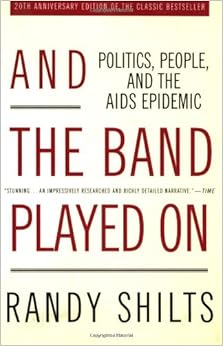
Beginning around 1980, homosexual men and IV drug users began to come into medical offices with strange diseases; this was especially prevalent in urban areas with large numbers of homosexuals. As these patients began to die, and larger numbers of patients came into medical offices with the same symptoms, city health departments began to take action. Journalist Randy Shilts in And the Band Plays On writes extensively on how San Francisco's Public Health Department did an excellent job in tracing the spread of the disease, but he also writes how other cities' Public Health Departments such as New York City's simply played off the issue as a "gay affair" despite the deaths (310). Shilts believes this was because at first, HIV only affected homosexual men and IV drug users-- a reflection of America's homophobia. As the disease spread, the media called it "gay cancer" even as heterosexuals begins to fall victim to the disease-- a further reflection of America's homophobia (137).
 |
| San Francisco's Castro District, one of the areas hit hardest by the initial HIV outbreak |
The US Center for Disease Control (CDC) remained effectively silent on the issue by not funding research at all (292-293). As the death toll grew higher and higher, the Reagan administration responded in 1983 calling it America's "Number One Health Priority," but the Reagan administration gave no extra funding to the Centers for Disease Control or the National Institutes of Health (NIH) for research (293-294). Shilts accuses Ronald Reagan himself of "ritualistic silence" until he publicly addressed the American people on the now termed AIDS epidemic in 1987 (588). To further illustrate his point, Shilts compares the NIH's spending on another public health crisis at the time (1976), Legionaire Disease, to their spending on the AIDS epidemic. The NIH spent roughly $34,841 per death from Legionaire Disease, but the NIH spent $8,991 per death from AIDS in 1982 (186).
 |
| A truly harrowing yet enlightening book. |
Call it a sin of omission, but I do agree with Shilts when he says America's response to the initial outbreak of HIV reflects its homophobia at the time. Indeed, I still encounter people who believe HIV is simply a disease that affects only homosexuals. Regardless of how one feels, America's initial reaction to the HIV epidemic continues to spark great controversy, and perhaps this will lead to greater dialogue in how to address this terrible disease that does not discriminate.


Have thee been any other significant works on this issue? What about at museums?
ReplyDeleteThe only exhibit I know of exploring the issue is a traveling exhibit made by the National Library of Medicine. The exhibit is called Surviving and Thriving: AIDS, Politics and Culture.
ReplyDeleteThere also have been multiple films exploring this topic including this year's The Normal Heart. It won Best TV Movie at this year's Emmys, in fact.